

In September, we launched our new Airline Digital Innovation Series. The idea is simple: give more space and exposure to smart people who are doing genuinely new things in aviation and bring those ideas to the wider Diggintravel audience.
We started with digital twins, one of the most intriguing concepts I’ve explored in a while. In simple terms, digital twins allow airlines and airports to create a parallel version of the real world where they can test ideas, simulate different scenarios and see several steps into the future before changing live operations.
The response to the first episode was very positive, but I also received several versions of the same question:
“This sounds great, but how do you actually build one?”
A fair question. An airport is an incredibly complex environment, with aircraft, vehicles, people, weather, operational systems and constantly changing conditions. Building a digital version of all that sounds like a huge project.
So, rather than moving on to the next topic, I decided to make Part II and dig deeper. How difficult is it to build the first proof of concept? What data do you need? How long does it take? And how can that first version gradually become more connected, dynamic and realistic?
Here is a small preview: an initial proof of concept can be built in only a couple of weeks, using publicly available data alone.
To understand how this works in practice, I spoke with Sebastian Huch, CTO of Autonoma and one of the people actually building these digital twins for airlines and airports. Sebastian comes from an academic, data science and engineering background and was part of the winning team at the 2021 Indy Autonomous Challenge.
Listen to the second episode of our Airline Digital Innovation Series. In this episode, we move from the big idea behind digital twins to the practical details of how airlines and airports can actually build one.
We explore how to create the first proof of concept, what can be done with publicly available data, how operational expertise is incorporated into the model, and how a digital twin can gradually evolve by connecting more data sources, systems and real-world knowledge.
Or, read on for the key takeaways, practical examples and a simple look at how airlines and airports can start building digital twins without beginning with a huge technology project.
And don’t forget to subscribe to the Diggintravel Podcast in your preferred podcast app to stay on top of the latest airline innovation, digital strategy, data science, AI, marketing and emerging technology trends.
Let’s start with the question I heard most often after our first episode: how do you actually begin building a digital twin?
The answer is much less intimidating than I expected.
An airline or airport does not need to start by connecting every operational system, preparing a perfect dataset or launching a large, multi-year technology project. The first proof of concept can be built in only a couple of weeks, using publicly available data alone.
As Sebastian explained:
“The very first implementation can be done within a couple of weeks.”
This initial model can combine publicly available sources such as satellite imagery, airport geometry, ADS-B surface and flight data, public flight schedules and weather information. Together, these inputs provide enough information to create a baseline digital version of the airport and begin testing a clearly defined use case.
The first pilot could demonstrate the digital twin on the customer’s own airport, simulate taxi times or support a surge-event planning study. The goal at this stage is not to recreate every detail of the airport. It is to build something tangible, test whether the model reflects reality closely enough and demonstrate whether it can help answer a useful operational question.
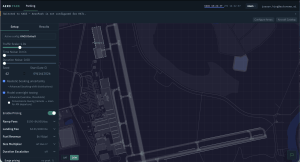
Once that first version is running and once the airport or airline sees value, the next step is to connect its own operational data. This could include flight schedules and statuses from the Airport Operational Database, gate and stand assignments from the Gate Management System, and surface-surveillance data where available.
These additional sources can turn the initial proof of concept into a more connected operational model. The digital twin can begin to provide a live operating picture, support gate, taxi and stand scenario planning, and produce predictions that can be validated against real operations.
And there is no single point at which a digital twin is completely finished. New operational systems, sensors, historical data and use cases can be added over time, bringing the digital environment closer to the real one and opening new possibilities.
“For a digital twin, it’s usually something that keeps growing over time. You add more data sources, and it’s kind of a never-ending story.”
At the most advanced stage, the digital twin can also incorporate turnaround and ground-handling events, deicing records, docking and apron-system outputs, computer-vision and video feeds, and historical operational data for backtesting. These inputs can support more proactive disruption foresight by helping teams anticipate what might happen and test possible responses before problems spread through the operation.
Airports and airlines can also connect external data and operational workflows and simulate the impact of major capital projects before committing significant resources or changing the physical airport.
Source: Autonoma
Sebastian shared two very different examples that demonstrate how flexible this approach can be.
The first is Augusta Regional Airport, a relatively small airport for most of the year. But during the Masters golf tournament, its operating environment changes completely. Hundreds of aircraft arrive during the week, and one of the airport’s two runways is temporarily used for parking.
The real challenge is that many of these are private aircraft without predictable schedules. An aircraft expected at two in the afternoon might arrive several hours earlier or later. The airport needs to decide where to park each aircraft, which ones should remain closer to the terminal and VIP areas, and how to keep enough space available for everything still to come.
Historical data provides a starting point. It shows previous arrival patterns, departure times and peak periods. But that data cannot explain every operational rule or decision.
As Sebastian emphasized:
“You can have all the data in the world, but usually the most important thing you should do is just talk to the people.”
Autonoma worked closely with Augusta’s experienced operational teams to understand how they had managed the Masters in previous years. Their knowledge helped define which aircraft could be parked together, which positions should be avoided and how different parking areas should be prioritized.
The digital twin then allowed the airport to simulate different demand levels, parking plans and possible arrival patterns. During Masters week, the model could be updated based on what had actually happened the previous day, creating a new operating picture for the day ahead. Augusta demonstrates how a smaller airport can use a digital twin to prepare for one extremely unusual and demanding week.
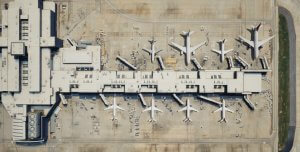
At the other end of the scale, Autonoma independently built a digital model of Hartsfield-Jackson Atlanta International Airport, the world’s busiest airport by passenger traffic. The team chose Atlanta as the ultimate test of whether its approach could scale to one of the most complex airport environments in the world. Instead of moving gradually from Augusta to a medium-sized airport, Sebastian and his team decided to test whether their approach could work in one of the most complex airport environments possible.
“We thought, why don’t we start with the busiest airport in the world?”
The basic building blocks remain the same: runways, gates, aircraft, schedules and weather. But the volume of traffic, number of interactions and consequences of each decision are dramatically larger. As Sebastian explained:
“In theory, every airport is similar. They have runways, gates and planes. But in the details, every single airport is different.”
Together, Augusta and Atlanta illustrate the range of possible digital-twin applications. One helps a regional airport prepare for an extraordinary annual surge. The other demonstrates how the same approach can be scaled and customized for the complexity of the world’s busiest passenger airport.
Source: Autonoma
Toward the end of our conversation, Sebastian gave us a glimpse into what could come next.
Today, operators can manually create and run different scenarios. In the future, AI agents could continuously monitor operations, weather and other signals, recognize an emerging problem, automatically build and run the relevant simulations, and present the most likely outcomes before anybody asks.
These agents could eventually go one step further by generating new ideas, testing different solutions and identifying opportunities that operational teams might not have had time to explore.
But Sebastian was also clear about one important principle:
“The final decision is always with the human, and it should stay like this.”
This is only a short preview of our more futuristic discussion. Listen to the full podcast conversation to hear how Sebastian believes AI agents could make digital twins more proactive, autonomous and useful to experienced airline and airport teams.
If you want to discover new ideas, technologies and emerging concepts with smart people and innovators who are pushing the boundaries of aviation, or simply want to be the first to know when the next episode of our Airline Digital Innovation Series is published:


No Comments