

After introducing the bigger picture in the first part of the How Airlines Become Data Driven series, it’s time to get much more practical.
In the previous article and podcast episode, I argued that becoming data driven is less about analytics tools and fancy dashboards, and much more about building habits, routines, and a shared understanding of the business.
But every journey needs a starting point.
I start every airline analytics consulting project by asking one simple question:
Can we trust the data we’re using to make decisions?
It may sound obvious, but I’m still surprised how many organizations can’t answer a simple question: How accurate is our digital analytics data compared to our backend systems?
Without understanding that, measuring campaign performance, evaluating experiments, or optimizing digital marketing becomes much harder. In some cases, it can even be misleading.
In this second episode, we’ll explore why measuring data accuracy should be one of the first habits every airline digital team builds, and how I typically measure, validate, and improve it in airline consulting projects.
It’s the foundation on which every other analytics and measurement activity depends.
Listen to the latest episode of the Diggintravel Podcast and the second part of the How Airlines Become Data Driven series. In this episode, we move from the big picture to one of the first practical steps of becoming data driven: measuring data accuracy, understanding tracking limitations, and building a trusted measurement foundation. Or, read on for the key takeaways.
And don’t forget to subscribe to the Diggintravel Podcast in your preferred podcast app to stay on top of the latest airline UX, digital strategy, marketing, data science and AI trends!
One thing that has consistently surprised me over the last five years is how many airline teams can’t answer a seemingly simple question:
How accurate is our digital analytics data?
Or more specifically:
How closely does it match our backend bookings and transactions?
That may sound like a technical detail, but it has implications for almost every decision a digital team makes. If you don’t understand how accurate your measurement is, evaluating campaign performance, measuring experiments, or optimizing digital marketing spend becomes much harder. That’s why data accuracy is the foundation of every analytics project I work on.
Only once we understand the quality of the data do we start discussing how to build proper trendlines, how to track campaign peformance, attribution, experimentation, or more advanced data science.
The challenge has also become more complex over the last few years.
For many organizations, Google Analytics used to be the obvious source for digital measurement. Today, privacy regulations, consent management, browser restrictions, ad blockers, server-side tracking, and a growing number of analytics solutions have made the landscape far less straightforward.
One thing I’ve learned over the last five years is that there isn’t one “correct” architecture.
Some airlines rely primarily on GA4. Others use Adobe Analytics, server-side tracking, custom platforms, or a combination of solutions. What matters isn’t which platform you choose. That decision depends on your organization’s resources, capabilities, budget, and technical maturity. It’s also a much bigger topic than we can cover here, and probably one that deserves its own episode.
What matters is understanding the strengths and limitations of your chosen approach, and validating it against a trusted source of truth before making important business decisions.
In the podcast, I discuss this evolution in more detail and explain how different airlines approach the challenge of building a trusted measurement foundation.
If there is one practical takeaway from this article, it is this:
Measure the accuracy of your data before you start optimizing anything.
Whether your primary analytics platform is GA4, Adobe Analytics, server-side tracking, or a custom solution doesn’t change that principle. The first step is always understanding how closely your digital analytics data matches your backend systems. For most airline ecommerce teams, backend bookings or transactions are the closest thing to a source of truth. They provide the benchmark against which digital analytics should be validated. The first metric I usually establish is the discrepancy between the two. For example, if your analytics platform reports 9,500 bookings while your backend reports 10,000, you immediately know you’re working with a 5% discrepancy. That number alone doesn’t tell you whether your tracking is good or bad, but it gives you a baseline.
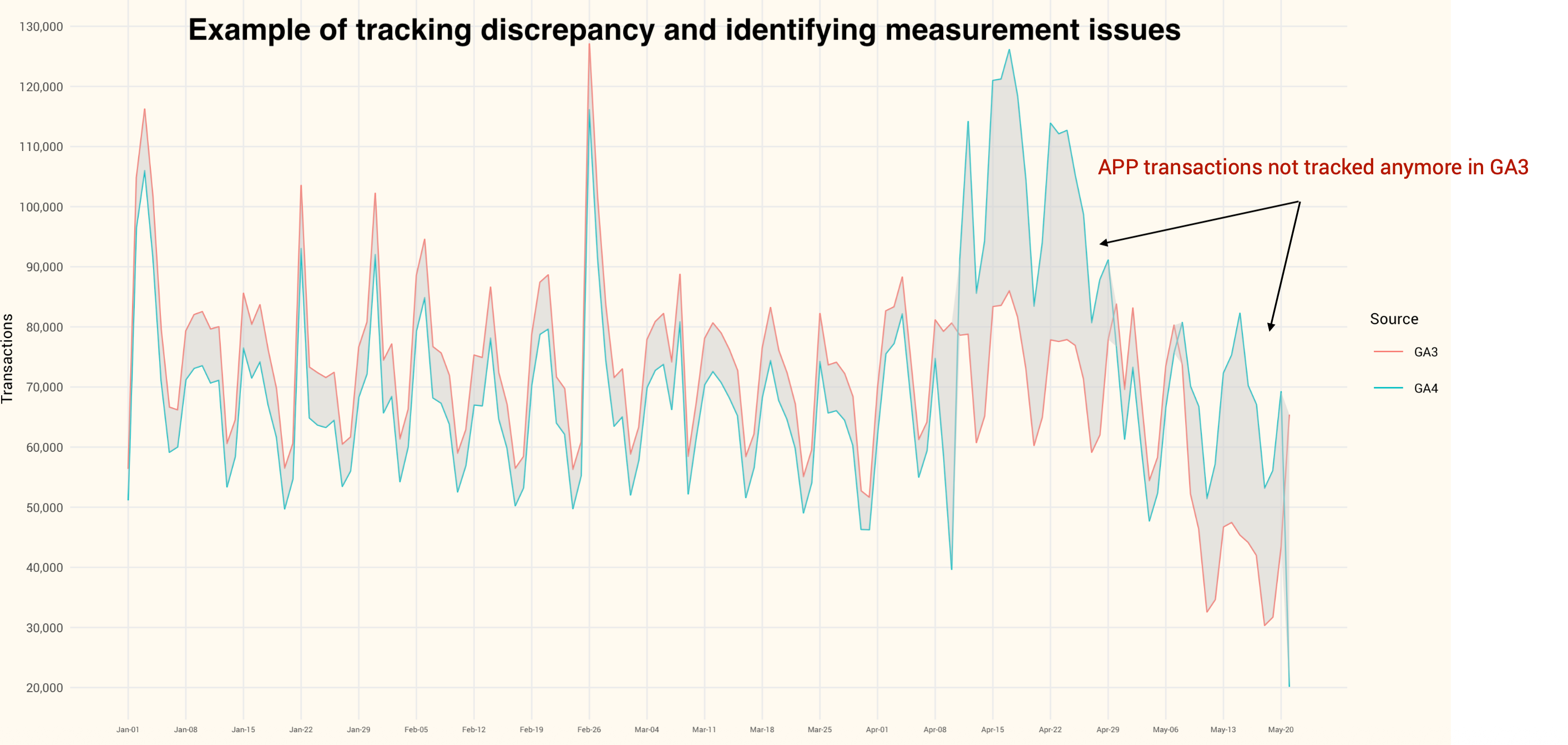
From there, you can start monitoring how that discrepancy changes over time. This is important because airline digital environments are constantly changing.
New website releases. Mobile app updates. Booking flow improvements. Tracking migrations. Consent management changes.
Every one of these changes has the potential to affect measurement quality.
Sometimes data simply goes missing. Sometimes events are duplicated. Sometimes only a specific browser, country, or customer segment is affected. And unless you’re actively measuring discrepancy, you may not even notice that anything has changed until it starts influencing important business decisions. That’s why I see discrepancy tracking as one of the first, simple but crucial habits every airline digital team should build. Not as a one-time audit, but as part of an ongoing process of validating, understanding, and continuously improving the quality of your measurement.
The goal isn’t to achieve perfect tracking. It’s to understand the limitations of your measurement, identify problems early, and improve data quality over time.
In my experience, a discrepancy of around 5% should be the goal. Once it consistently moves above 10%, I start looking much more closely at what’s happening. Those aren’t universal thresholds, but practical guidelines that have worked well across multiple airline projects. The key is to measure the discrepancy consistently. Because once you start tracking it every week, something interesting usually happens.
Patterns begin to emerge.
You start identifying recurring issues.
And eventually, you understand where those discrepancies come from and how to improve them.
The example below shows one way of tracking discrepancy over time and using it as an early warning system for potential tracking issues.

Finding a discrepancy is only the beginning. The overall number tells you that something isn’t right. It doesn’t tell you what’s causing it. That’s why one of the first things I do after identifying a discrepancy is start breaking it down into smaller segments.
Countries. Markets and routes. Devices. Browsers. Traffic sources. Customer segments.
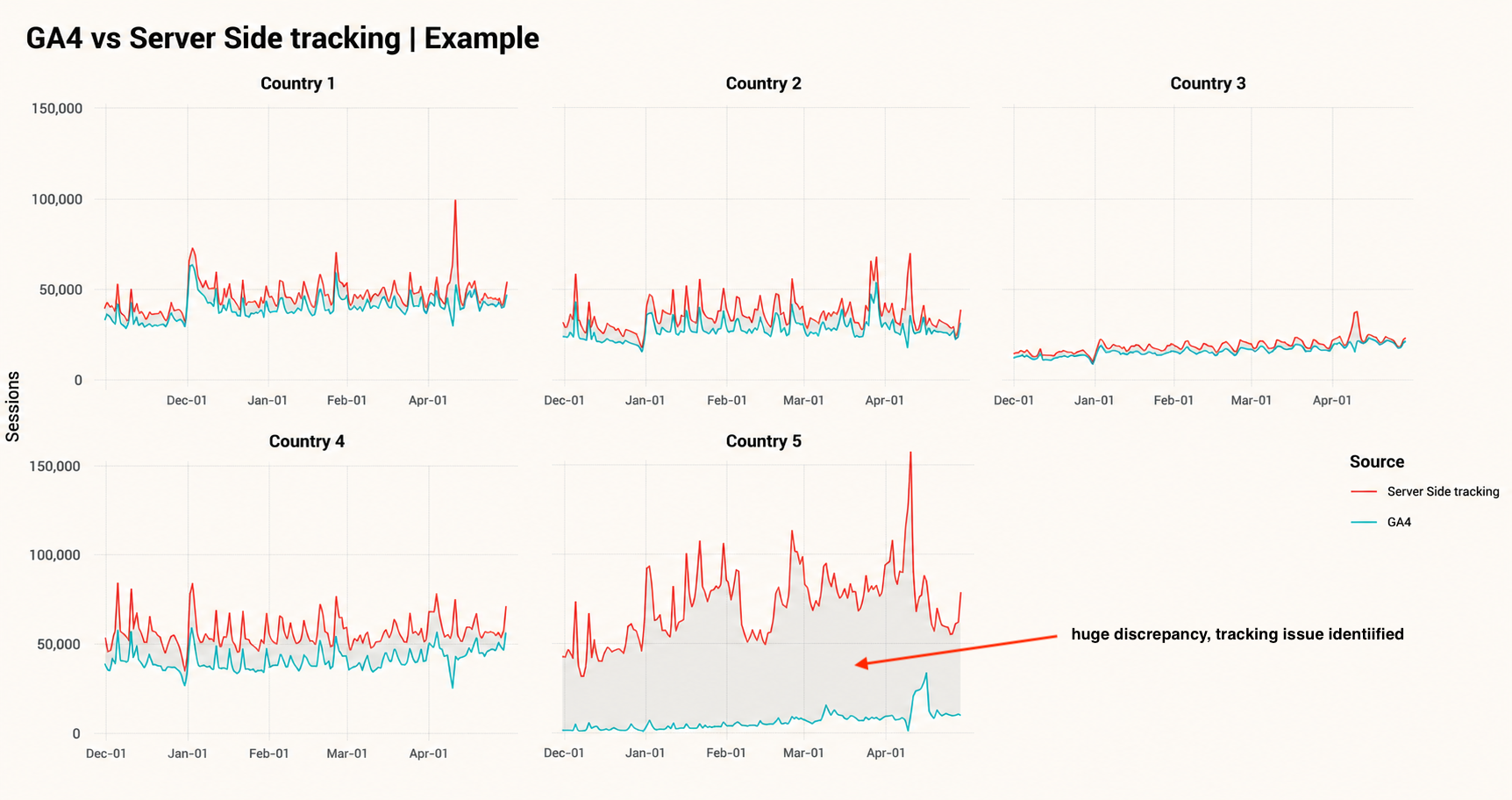
The right segmentation depends on your business and the problem you’re trying to solve, but the principle is always the same: keep digging until the patterns start to emerge. In one project, we identified a much larger discrepancy than expected after an airline migrated from Universal Analytics to GA4.
Looking only at the overall number, we knew there was a problem, but we had no idea where it was coming from. It was only after we started analyzing the discrepancy market by market, across more than 40 countries, that the root cause became clear.
The issue wasn’t GA4 itself. It was the way cookie consent and GDPR rules had been implemented for a subset of non-EU users. Once we found the source, the fix was relatively straightforward, and the discrepancy returned to an acceptable range.
The example below illustrates how breaking down the overall discrepancy into smaller segments helped us move from simply identifying a problem to understanding exactly where it originated.
In this article, I focused on one practical lesson that has become a constant in my consulting work: before you optimize anything, you need to understand how accurate your data really is.
The examples here only scratch the surface. In the podcast episode, I go into much more detail about why digital measurement has become more challenging over the last few years, how different airlines approach analytics architectures, and the practical process I use to measure, validate, and improve tracking accuracy over time.
In the next article and podcast episode, we’ll take the next step. Once we’ve established a trusted measurement foundation, we’ll look at how to bring together backend bookings, web analytics, flight searches, and digital marketing data into one consolidated view of airline digital marketing performance. From there, we can start identifying trends, understanding the relationship between marketing activities and business results, and generating better insights.
If you’re enjoying the How Airlines Become Data Driven series and want to learn more about airline analytics, measurement, experimentation, ecommerce, digital marketing, and building more data-driven organizations, here are a few ways to continue:


No Comments