

For years, much of our Diggintravel content has focused on airline digital optimization. We’ve preached testing and experimentation, conducted airline digital experimentation benchmarks, published yearbooks, and explored how airlines can use data and scientific decision-making to improve their digital businesses.
Now, we want to expand that conversation. With our new Airline Digital Innovation Series, we want to give more exposure and a stronger voice to smart people and industry innovators who are pushing boundaries and bringing genuinely new ideas into aviation.
Digital twins felt like the perfect place to start. A few years ago, I spoke with Harvard Business School professor Stefan Thomke about how business experimentation brings scientific thinking into management decisions. Later, Andrés Bucchi shared how LATAM Airlines was taking experimentation beyond digital channels and into the physical airline world.
Digital twins take that idea another step forward. When we talked a few years ago about running experiments in the physical airline world, some of those ideas still felt futuristic and abstract. That’s why I’m so excited to now see them being applied to real airline and airport operations. Digital twins allow airlines and airports to test assumptions, de-risk ideas, and simulate what might happen before making changes to live operations. In a nutshell, they allow airlines and airports to see and test the future before it happens.
My guest for this first episode is Will Bryan, CEO of Autonoma, a company built around data science, simulation and innovation. Before bringing digital twins to aviation, Will was doing some seriously fun and sophisticated work with autonomous racing cars, including competing in the Indy Autonomous Challenge. Now, he’s taking what he learned from cars racing at extreme speeds without drivers and applying it to an even more complex environment: airlines and airports.
Listen to the first episode of our new Airline Digital Innovation Series. In this episode, we explore what digital twins are, how they differ from conventional simulations, and how airlines and airports can use them to test ideas, anticipate operational challenges, and make better decisions before changing live operations.
Or, read on for the key takeaways, practical aviation use cases, and a glimpse into how digital twins could shape the future of airline and airport operations.
And don’t forget to subscribe to the Diggintravel Podcast in your preferred podcast app to stay on top of the latest airline innovation, digital strategy, data science, AI, marketing, and emerging technology trends.
Let’s start with the obvious question: what exactly is a digital twin?
As Will admitted during our conversation:
“Digital twin is one of those buzzwords, like AI, that has 20 different meanings.”
There is no single type of digital twin. At its simplest, it can be a digital representation of a physical object or environment, such as an aircraft, an airport or a specific operational system. It might combine several data sources and display what is happening through a 2D dashboard or a 3D visualization.
But an attractive visualization alone does not make something a useful digital twin.
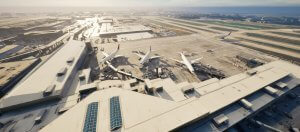
More advanced digital twins are connected much more closely to the real environment. They combine historical and live operational data with physics, sensor inputs and operational rules to represent how a complex system behaves. As conditions in the physical world change, the digital environment can change with them.
This is where the distinction between a conventional simulation and a digital twin becomes important. A simulation usually tests a predefined scenario using a set of fixed assumptions. A digital twin can continuously reflect real-world conditions, allowing teams to test different decisions and explore their potential consequences within a changing operational environment.
Source: Autonoma
A key part of this is sensor fusion. In simple terms, sensor fusion means combining information from different sources, each with its own strengths and limitations, to create a more complete and reliable view of reality. In aviation, this could mean bringing together aircraft positioning data, airport operational databases, schedules, weather information and other live data feeds.
Will experienced the importance of this connection between the virtual and physical worlds while working with autonomous racing cars. His team could build software that worked perfectly in simulation, only to see the car behave very differently on a real racetrack. The simulation became genuinely valuable only when it could account for the messy variables, uncertainty and edge cases found in the real world.
And that is the real purpose of a digital twin. It is not simply to show what an airport looks like digitally. It is to create a realistic environment in which airlines and airports can test decisions, understand their possible consequences and learn before making changes to live operations.
Airlines and airports cannot freely experiment with live operations. The combination of safety requirements, operational complexity, disruption and cost makes failure extremely expensive.
Digital twins provide a safer environment in which teams can test assumptions, compare different choices and understand their possible consequences before making changes in the real world.
But this is not only about avoiding mistakes. It is also about de-risking great ideas. Aviation is understandably risk-averse, which means promising operational ideas can be difficult to test under live conditions. Digital twins give experienced airline and airport teams more freedom to be daring, experiment with different approaches and test ideas that might otherwise be considered too risky to try.
“They have some things they want to try that are a little too high risk to try without testing them some other way first.”
Digital twins provide exactly that alternative. Teams can test those ideas virtually, identify which ones are likely to work and improve them before introducing them into live operations.
Importantly, the goal is not to replace experienced operational teams. These teams already make difficult decisions every day, often under significant pressure and with incomplete information. Digital twins allow them to embed years of real-world operational experience into the models, examine more scenarios, compare more options and see further into the future. As Will explained:
“We’re still using the tools and the things they’re teaching us. We’re just doing it at a scale that an individual can’t.”
Will compared this to playing chess. A good player might see two or three moves ahead, while a grandmaster might see ten. In a similar way, digital twins can help experienced operational teams anticipate the consequences of a decision several moves earlier.
Here are three practical ways airlines and airports can use digital twins today.
Airside operations involve a constantly changing combination of aircraft, gates, stands, ground vehicles and people. A decision in one part of the airport can quickly affect several others.
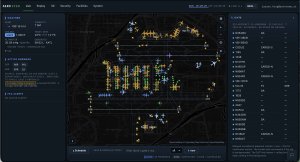
Digital twins can help teams test different gate and stand assignments, aircraft routing, vehicle movements and operational sequences. They can identify potential conflicts before they affect live operations and show what could happen when one part of the plan changes.
The same approach can support longer-term decisions. Airports can simulate a new terminal, infrastructure change or the arrival of a new airline before committing significant resources or disrupting existing operations.
Source: Autonoma
Weather and other irregular operations rarely affect only one flight. A reduction in airport capacity can quickly spread across gates, aircraft rotations, crews, connecting passengers and the wider airline network.
Digital twins can simulate different versions of an approaching disruption and run hundreds or thousands of scenarios in parallel. Teams can then compare possible mitigation strategies and understand which flights, aircraft or parts of the operation are most likely to be affected.
This allows airlines and airports to act earlier rather than simply react once the disruption is already happening. It can also improve the passenger experience. A delay is never good news, but receiving reliable information early is much better than experiencing a series of rolling 15-minute delays while sitting at the gate or on the aircraft.
Digital twins can also help airports prepare for unusual events that push operations far beyond normal traffic levels.
Will shared a fascinating real-world case that Autonoma worked on with Augusta Regional Airport during the Masters golf tournament. The airport can go from handling a few dozen flights per day to around 600 flights per day during the event, with more than 200 aircraft parked on the ground at the same time.
The challenge is not simply predicting how many aircraft will arrive. Many are private flights that do not follow predictable schedules. The airport must determine where to park them, how to route them and how to keep ground operations moving without making the plan too complicated for the teams executing it.
By testing different parking, routing and ground-handling plans in advance, the airport can make better use of its existing capacity, reduce the risk of aircraft being turned away and provide a smoother experience during one of its most demanding weeks of the year.
These examples illustrate the real value of digital twins. They allow experienced teams to test their best ideas, identify problems earlier and make more confident decisions before those decisions affect live operations.
In the final part of our podcast conversation, we allowed ourselves to look further into the future. We talked about where digital twins and real-world aviation simulation could go next, and how this technology could eventually improve our lives and the overall travel experience.
Will described continuously running simulations that react automatically to new information, recognize emerging disruptions and test hundreds of possible mitigation strategies before an operations team receives its first alert. Further down the line, individual airline and airport digital twins could become connected, allowing different parts of the aviation network to anticipate how events in one location will affect operations elsewhere. Will compared this future aviation system to the human body:
“It’s like the human body. It’s self-healing.”
That is only a small preview of Will’s vision. But behind all the technology, data and simulation is a very human goal:
“At the end of the day, that’s what makes it not just safer, but a better travel experience for every single one of us.”
Make sure to listen to the full podcast conversation to hear how Will believes digital twins could develop over the next three to five years and help create a more connected, predictive and resilient aviation system.
If you want to discover new ideas, technologies and emerging concepts with smart people and innovators who are pushing the boundaries of aviation, or simply want to be the first to know when the next episode of our Airline Digital Innovation Series is published:


No Comments