


After spending much of 2025 on our Airline Leaders Series, in cooperation with our partners at 815Labs, talking to airline CMOs, CDOs, and digital leaders, we decided to close the year with something a bit different.
Instead of another high-level leadership conversation, we wanted to dig deep into one specific topic—one that kept coming up in those interviews, sits high on many airline agendas, and that a lot of you, our readers and listeners, told us you want to better understand. So yes, today we’re talking about Generative Engine Optimization (GEO) for airlines.
To do that, I traveled to Budapest to sit down with David Minorics, Business Development Director at Mito Performance. Through Mito’s airline-focused branch, 815Labs, David has worked on numerous airline digital marketing and SEO projects over the years. With a strong background in SEO and analytics, he has since extended that expertise into GEO, and is now leading GEO pilots and projects for different clients—including airlines.
At Diggintravel, we always try to bring you not only insights from top airline industry leaders, but also in-depth knowledge and deep dives into topics and trends airline marketers need to understand. I truly believe this podcast conversation will be insightful for anyone who wants to learn more about Generative Engine Optimization (GEO).
We did a special video recording for this episode of the Diggintravel Podcast, recorded in a podcast studio in Budapest.
You can watch the full video here, listen to the episode in podcast form on your favorite platforms, or read on for the key highlights and summary visuals from our conversation with David.
Podcast also available in podcast format here:
And don’t forget to subscribe to the Diggintravel Podcast in your preferred podcast app to stay on top of the latest airline AI, GEO, digital strategy, marketing, data science and other trends!
Below are key takeaways from our conversation with David Minorics. To fully understand what Generative Engine Optimization (GEO) means for airlines, how it differs from traditional SEO, and how airline marketing teams can start experimenting with it today, watch the full video or listen to the complete podcast episode. David shared so many practical insights that investing 50 minutes to watch or listen is definitely worth it.
1. What is GEO and how is it different from SEO?
The most important thing to understand upfront is that GEO is not SEO—and applying the old SEO playbook one-to-one simply won’t work. The fundamentals may feel familiar, but the mechanics and the outcomes are changing fast.
At its core, SEO is about being found. It focuses on how your brand appears when users conduct searches in traditional search engines and how well you rank on a results page. GEO, on the other hand, is about being favored. It’s about how AI systems describe your brand, whether they recommend it, and which topics, routes, or use cases they associate your airline with.
As David put it during our conversation:
You want to be mentioned in a good place and also in a positive atmosphere. That’s what we are focusing on with GEO.

source: Mito group
Another fundamental shift sits at the very base of information retrieval. In classic SEO, users synthesize information themselves by scanning the search engine results page (SERP), clicking links, and comparing sources. In AI-powered search and discovery (AIO), that synthesis is done by the machine. AI pulls information from multiple sources, combines it, and delivers a single, structured answer.
GEO builds on this reality. Instead of optimizing for a single keyword and a single query, AI systems use techniques such as query fan-out, running multiple concurrent searches in the background to construct an answer. The result is a move from single-query optimization to multi-source, AI-mediated recommendation—where visibility, context, and sentiment matter far more than rankings alone.
Just as in the original SEO world there was technical SEO, content SEO, and link building, this is how you start GEO as well. AI has to find your website, and it also has to understand what is on your website.
While GEO is not SEO, it does have a clear structure. In practice, GEO sits at the intersection of content, AI understanding, and relevance optimization.
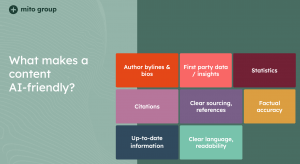
The first element is content. AI systems need clear, structured, and intent-driven content to work with. The second element is AI understanding. It’s not enough for content to exist; AI must be able to find it and interpret it correctly. As David explained, the foundation is still technical:
AI has to find your website, and it also has to understand what is on your website.
This means simple, crawlable site structures, readable language, and avoiding technical setups that only Google can interpret. The third element is relevance optimization. In GEO, relevance is no longer driven primarily by links, but by mentions, context, and trust signals across the wider web. AI engines heavily weigh user-generated content, authoritative third-party sources, and consistent brand associations when deciding which airlines to recommend.
As David put it succinctly:
You don’t need links anymore. You need mentions.
Together, these three elements form the GEO playbook: create content AI can use, make sure AI can understand and interpret it, and build relevance and trust beyond your own website
source: Mito group
3. GEO measurement, benchmarks, and KPIs
Measuring GEO performance requires a very different mindset from traditional SEO or digital marketing analytics. One of the first things airline marketers need to accept is that GEO operates largely outside first-party analytics tools.
AI platforms don’t share prompt volumes, user journeys, or detailed engagement data. Much of the discovery process happens without clicks, impressions, or trackable sessions ever occurring. As David put it very clearly:
You won’t see that data in your GA4 or any other analytics system that you use. And you won’t even see it in your GEO account. But you still get the results.
This is why benchmarking becomes the starting point for any GEO initiative. Before optimizing anything, airlines need to understand where they currently stand in generative engines. This typically means running both branded and non-branded prompts across AI tools like ChatGPT, Gemini, and Perplexity to assess:
Once that baseline is established, airlines can track change over time—not through clicks, but through visibility and sentiment shifts in AI responses.
source: Mito group
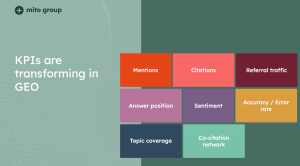
When it comes to KPIs, GEO focuses on a smaller, more outcome-driven set of signals:
Because direct attribution is no longer possible, GEO measurement relies on experimentation, comparison, and data science thinking rather than perfect funnel tracking. The goal is not to see every step, but to confidently answer a more important question: Is increased visibility in generative engines contributing to real business results?
If you want to learn more, make sure to listen to the full podcast episode. In our conversation, David goes deeper into how GEO benchmarking works in practice, what is specific to airlines and the travel industry, how he recommends starting a GEO project, and what his team has learned from running GEO pilot projects, including projects with airlines.
If you want to learn from leaders like David about airline UX, mobile, digital optimization, data science, and AI, or just want to be the first to know when our next interview will be published, please:


No Comments