

After a six-month break, the Diggintravel Podcast is back.
Over the last few years, Diggintravel has evolved from practical articles on airline digital marketing, ecommerce, UX, and analytics into a platform featuring conversations with airline leaders, digital executives, and industry experts. Those discussions resulted in more than 70 podcast episodes and countless lessons from some of the smartest people in the industry.
But while the interviews were happening, I was also spending most of my time doing something else: working directly with airline ecommerce and digital marketing teams.
Over the last five years, I have been fortunate to support airlines of different sizes and maturity levels on projects focused on analytics, measurement, ecommerce growth, experimentation, and building more data-driven organizations.
This article and podcast episode mark the beginning of a new Diggintravel series: How Airlines Become Data Driven.
Over the next episodes in this series, I’ll share practical lessons and observations from those consulting engagements. We’ll talk about measurement, analytics, experimentation, organizational alignment, and the realities of building a data-driven culture inside airline organizations.
The goal isn’t to provide another analytics framework.
Instead, I want to share what I observed working alongside airline teams, what surprised me, what worked, and where organizations tend to struggle.
In this first episode, I want to start with the biggest lesson of all.
Listen to the latest episode of the Diggintravel Podcast and the first part of the new How Airlines Become Data Driven series. Drawing on five years of consulting work with airline ecommerce and digital marketing teams, I share some of the biggest lessons I’ve learned about measurement, analytics, organizational alignment, and building data-driven culture. Or, read on for the key takeaways.
And don’t forget to subscribe to the Diggintravel Podcast in your preferred podcast app to stay on top of the latest airline UX, digital strategy, marketing, data science and AI trends!
Over the last five years, I have worked with airline ecommerce and digital marketing teams operating in very different environments. Some were relatively small organizations where a handful of people wore multiple hats. Others were much larger teams competing across dozens of markets and managing millions in digital marketing spend every year.
The projects themselves varied as well.
Some engagements focused on establishing measurement foundations and improving data quality. Others centered around ecommerce growth, customer segmentation, experimentation, or understanding the relationship between marketing activities and business results.
The maturity levels were equally diverse.
Some teams were still building the basics: collecting data, validating tracking, and creating the first processes for turning information into decisions. Others already had strong foundations in place and were looking for deeper insights, better market understanding, and more sophisticated ways to measure performance. The most advanced teams were trying to answer a much harder question: not just what happened, but how much impact their actions actually had.
Despite all those differences, one thing kept surprising me.
The biggest differences between organizations rarely came down to airline size, team size, budget, or technology. The biggest difference was maturity. And more specifically, how consistently teams used data to learn, make decisions, and build a shared understanding of the business.
That observation became the starting point for almost every project.
And it is also the starting point for this series.
One of the assumptions I had before starting these projects was that larger airlines would naturally be more data driven than smaller ones. In reality, that wasn’t always the case.
While larger organizations often had access to more resources, bigger teams, and more sophisticated tools, those advantages didn’t automatically translate into better decisions or a stronger analytical culture.
What mattered much more was maturity.
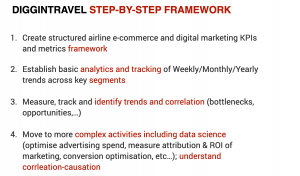
Over time, I started thinking about airline organizations in three broad stages.
The first group was focused on building foundations.
These teams were working on collecting data, validating tracking, improving reporting, and establishing the first processes that would allow them to measure performance consistently. The goal wasn’t advanced analytics. The goal was trust. Trust in the numbers. Trust that the team was looking at the same version of reality.
The second group had already established those foundations.
Data collection worked reasonably well. Reporting existed. Teams generally knew what was happening in a specific part of the business. The challenge was moving beyond fragmented reporting. These organizations wanted to understand trends, identify opportunities, spot outliers, compare markets, understand competitors, and connect marketing activities with business outcomes. A big part of the work involved bringing together different data sources that often lived in separate systems and teams.
Ecommerce platform data. Back-end overall performance. Marketing spend from platforms like Google Ads and Meta. Website traffic and user behavior. Flight searches. Bookings and revenue.
The goal wasn’t simply to create more dashboards. It was to build a common view of the business, a shared trendline and story that everyone could understand and discuss. The conversations became less about collecting information and more about consolidating it, and interpreting it.
The third group was pursuing something even harder.
They wanted to move from correlation toward causation.
Not simply understanding what happened, but understanding the impact of their actions. How much incremental value did a campaign create? What effect did a change in investment have on bookings?
Which activities were truly driving results?
This is where experimentation, advanced analytics, and eventually more sophisticated data science approaches started entering the conversation.
What I found interesting was that regardless of where an airline started, the journey usually took much longer than expected.
Most projects began as six-month engagements. Very few stayed that way. The reason was simple. Building a data-driven organization isn’t a project with a clear finish line.
It’s a capability that develops over time.
And that realization led to another observation.
The biggest challenge wasn’t collecting more data. It was helping organizations make sense of the data they already had. Most airlines are not suffering from a lack of information.
They have data from analytics platforms. Data from marketing channels and advertising platforms. Data from ecommerce systems. Data from revenue management tools. Data from CRM tools. Data from customer feedback.
The challenge is rarely finding more data.
The challenge is turning all of that information into a shared understanding of what is happening in the business.
That’s why I became such a big believer in routines.
Weekly reviews. Weekly trend discussions. Weekly opportunities to step back from the day-to-day rush and ask a few simple questions:
What trends are we seeing?
What changed?
What surprised us?
How are trends connected? Is there a correlation? Can we measure it?
What don’t we understand yet?
These conversations may sound simple, but over time they become incredibly powerful. Because they create context.
Context is often what organizations are missing. Especially in an industry where priorities shift constantly. New campaigns launch all the time. New routes open. Promotions get extended, or they get cancled. Competitors react. Targets change. Teams change.
And in that environment, knowledge can easily become fragmented across departments and individuals. Or sometimes lost all together.
Another lesson I didn’t fully appreciate before working closely with airline teams was how much of the work had very little to do with data itself. In theory, everyone is working toward the same goal. In practice, marketing, ecommerce, analytics, IT, UX, CRM, and leadership often look at the business through very different lenses.
Each team has its own priorities. Its own metrics. Its own language. Its own perspective.
One of the most valuable things we ended up doing was not building more dashboards.
It was helping create a common view of the business. Bringing different teams into the same conversation. Looking at the same trends. Discussing the same questions. Understanding how decisions in one area affect results in another. And sometimes simply helping connect the dots between teams that don’t naturally spend enough time talking to each other. In many ways, a big part of becoming data driven is not about technology.
It’s about alignment.
It’s about making sure everyone understands where the business is trying to go and how their work contributes to that goal. Because when teams operate in silos, even the best data struggles to create meaningful change. When teams share context and understanding, the value of that same data increases dramatically. That is probably the biggest lesson I learned over the last five years.
Becoming data driven isn’t something you install. It isn’t a dashboard. It isn’t a new reporting tool. It isn’t even an analytics project.
It’s a process.
It’s a habit.
It’s a culture.
And it takes much longer to build than most people realize.
After working alongside airline teams, one thing became clear to me: becoming data driven is rarely about finding more data.
It’s about helping organizations develop the habits, routines, and shared understanding needed to turn information into better decisions.
Simple in theory.
Much harder in practice.
In the next article and podcast episode, we’ll move from culture to measurement and get much more practical.
We’ll explore one of the biggest challenges facing airline teams today: how do you know if you can trust the data you’re looking at?
We’ll discuss GA4 tracking, backend data, server-side measurement, measuring discrepancies, and why trusted data foundations are critical before any organization can become truly data driven.
If you enjoyed this first part of the How Airlines Become Data Driven series and want to learn more about airline analytics, measurement, experimentation, ecommerce, digital marketing, and organizational transformation, please:


No Comments